




I am learning that there is always something to complain about. If I'm forced to wait until dark before I can set up my tent and sleep, because I'm scared of being spotted and robbed in the night by Senegalese kids, then my mind complains about this. When I decide to save myself from burnout, by staying for two nights in an expensive hotel (my only option at the time), my mind tells me to work for this luxury: I need to wash my clothes, charge my electronics, pump up my tires, improve my blog, write a post, research visa requirements for the next countries. Relaxation is not allowed. Why does my brain work this way?
My mind says that once I reach Cape Town, I will be able to relax and I'll feel different, but I know this feeling won't last for more than a day. So I ask myself the same question: Why am I doing this?
A well-known spiritual teacher said something like, "You are more likely to wake up when you are not comfortable," so perhaps a part of me is trying to wake up.
The story from Western Sahara
I met a Moroccan and an Englishman on the road to Dakhla (the ones with carbon fibre bikes):
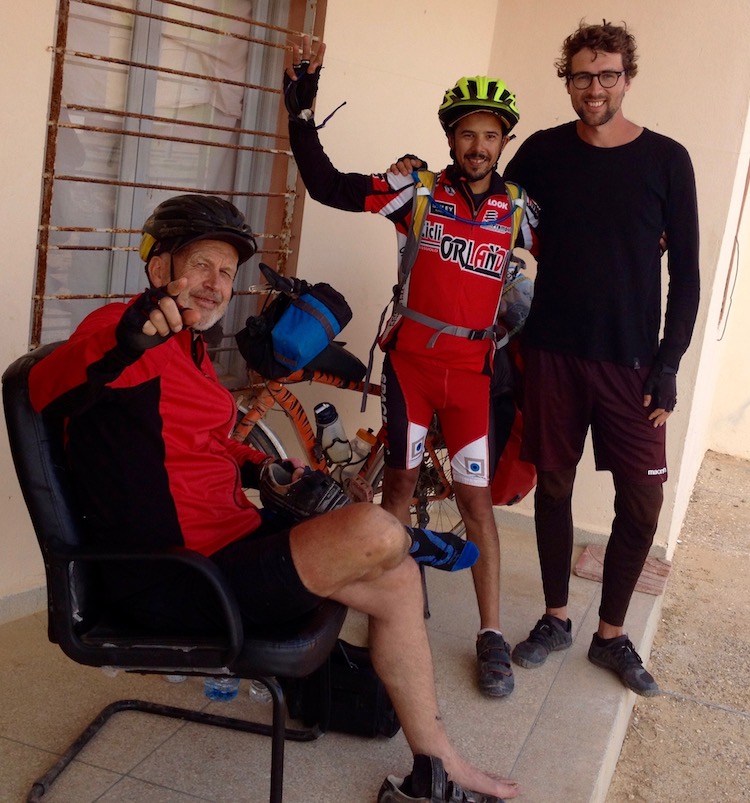
They went ahead of me to Dakhla, but Mohamed (the Moroccan) invited me to stay there with his family.
After catching up with them the next day, I stayed in the city for three nights, which was both extraordinary and surreal.
Mohamed had cycled into the centre to meet me, and then led me to a restaurant where we had lunch with Tim (the Englishman) and one of Mohamed's friends. Afterwards, he took Tim and I back to the house of his brother-in-law, Ismail.
The neighbourhood looked (and probably was) unfinished. To get to the house, we had to leave the road and cycle briefly on gravel and sand. The main components of the streets were sand and dust on the floor, breeze blocks and bare cement for the buildings, and iron grates over windows (styled in appealing patterns).
The facade of Ismail's house blended in with the neighbourhood. But when the door was opened, I was led into a different world. It was like walking into a high-end, London nightclub (this has never happened to me, but it's how I imagine it), or the private back room of an expensive restaurant. The floor and walls were coated with porcelain tiles, patterned ornately with brown and blue shapes, and sunken into the ceiling were tasteful lamps (Mohamed is a lamp salesman). The lamps illuminated the length of a central corridor, which ran from the front of the one-storey house to the rear. Aside from the lack of windows, the reason it felt like a nightclub was because of two communal rooms that were situated in 'booths' off the main corridor. They were separate rooms, but instead of having doors, their entrances were simply artful openings in the wall.
Each booth was simple and spacious. The first was for dining and tea drinking, and had ornate lamps in the ceiling, which could produce white, blue or purple glows. This complemented the patterned, blue felt of a sofa that lined the entire perimeter of the room. And positioned in one corner, was a round table with a tablecloth that matched the sofa and wheels so it could be moved around. Aside from these things, there was nothing else in the room, which gave it the impression of a void that required filling with people. This was an inviting and comfortable space.
The second booth seemed more for relaxation. It was similar in size to the first, but instead of having seating, the edge was lined with lounge mattresses and cushions. The entrance was also larger, so occupants could lay back and watch a flat-screen TV that was fixed to the wall in the corridor.
My stay was punctuated with eating, and it was some of the best food that I've ever had. Each meal was like a unique adaptation (or upgrade) of a staple Moroccan dish, like chicken tagine or grilled beef. Extra ingredients had been added, which I hadn't tasted before in the same dishes, like onions and herbs (and maybe more) in the grilled beef. But the breakfasts... Each morning, I died and went to heaven:

I should mention that such meals are not normal, but because there were so many guests in the house, Amal and Touriya (Mohamed's and Ismail's wives), were going all out in the kitchen. Four times a day.
While the food was overwhelmingly good, it felt awkward to have the women confined so strictly to the kitchen (and eating separately), which seems to be Moroccan custom when there are guests. On multiple occasions, Tim and I offered to clear up, but were firmly denied.
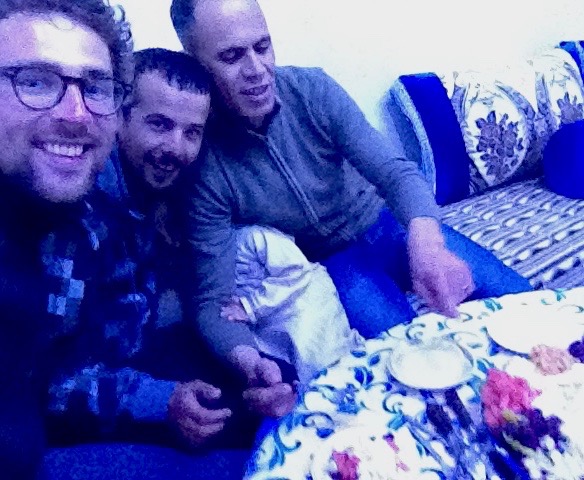
Here I am with Mohamed and Ismail at the table (with Ismail's son hiding from the camera):
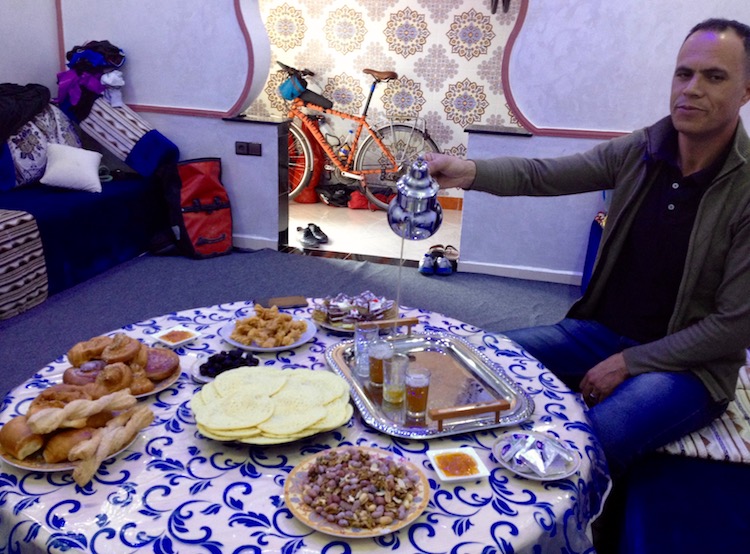
And here, Ismail is pouring tea (Moroccan style) while looking straight into the camera and not spilling a drop:
Thank you very much Mohamed, Amal, Ismail, Touriya and family!
Reaching Mauritania
From Dakhla to the border, the landscape became more rocky, with the occasional sea of red:

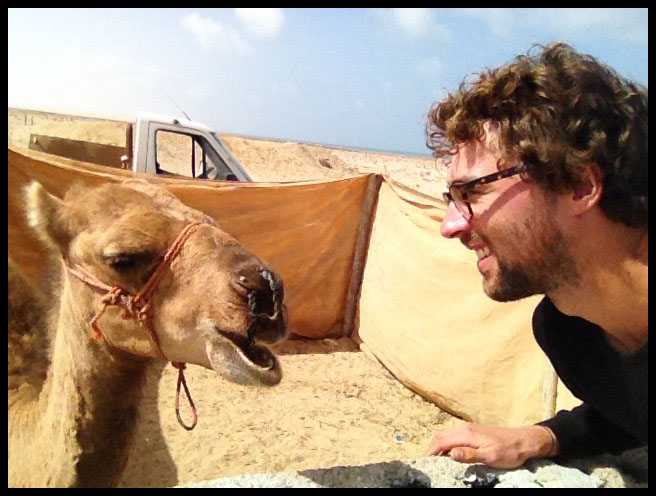
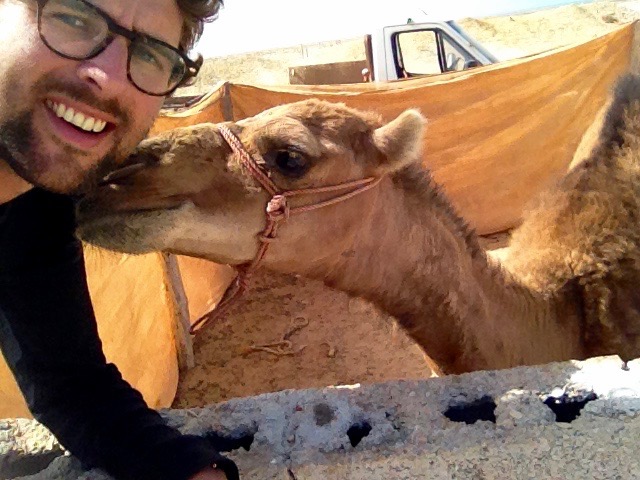
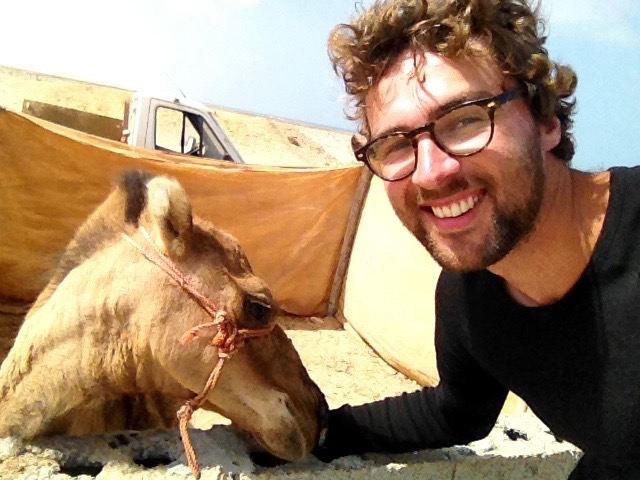
And I met this camel at a restaurant (I was trying to take a selfie):
 |
 |
Crossing the border to Mauritania was interesting. After I was stamped out of Western Sahara (by Moroccan authorities), I passed through a large gate and into an area that belongs to no country. Meters from armed Moroccan police, are black market dealers, offering money exchange and SIM cards. The ground is strewn with litter and the surrounding dunes are filled with stripped-out car wrecks, some overturned or burned. The area used to be a war zone, then became infamous for banditry, but is now apparently much safer, though it didn't feel that way.
It was five kilometres to the other side, so I began cycling, weaving my way around parked cars full of people and countless trucks (taking up the entire road at points), with the occupants seemingly living in them.
At one point, I stopped to take this photo:

I was immediately shouted at by a man walking towards me, who waved his finger, indicating that I shouldn't take photos. I tried to ask why, but he just walked by.
With one kilometre to go, the road stopped:

You can see trucks (from the other side) weaving their way across the bare rock and sand, trying to find a path to the road.
There was no obvious route, so I headed for the large antenna in the distance.
I'm sure I was safe, but it was in this section that I felt the most exposed. There were lone, beat-up cars rolling slowly over the rocks, which for some reason reminded me of pirate ships, with their dark windows and mismatched panels.
After a lot of walking and dragging my bike through sand, I made it to Mauritania and paid €55 for the visa.
Sand, huts and car wrecks
My time in Mauritania was short, but my impression of the country was that it is bleak: It felt like Morocco, but with the fun stripped out.
The landscape is strewn with shelters made from wood and corrugated metal, with the occasional car wreck, like this one, almost lost in the sand:

I felt a mixed reception from the locals: Some unfriendly stares, hostile gestures and kids throwing rocks, but also some kindness. Many drivers stopped to give me bottles of water or oranges. One truck flew passed and the driver threw two oranges out of his window onto the sand, which I was so grateful for, as I hadn't had fruit in many days.
Two days from the capital, Nouakchott, I stopped by this cluster of buildings to find a place to camp that was sheltered from the wind:
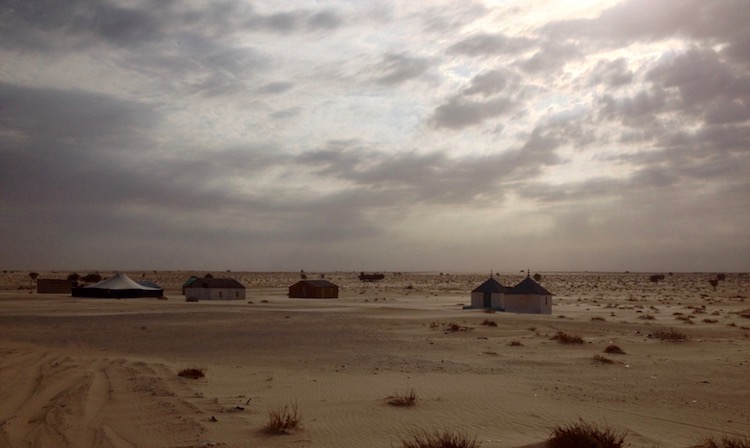
I asked a man if I could camp near one of the buildings, hoping for the kind of welcome I had grown used to in Morocco. He told me that I would have to pay. Then he said that I could stay in one of the huts for the same price (200 Ouguiya/£4), which was reasonable, so I accepted.
The man then asked if I had any antibiotics for his fingers, two of which were wrapped in bandages. He unwrapped one and showed it to me, and it looked infected. One was from a cut and one from a burn. I don't carry antibiotics, but I showed him the tube of antiseptic cream that I had, and said he could use some (I'm not sure how much this would have helped).
He took me into one of the larger tents and I sat with him, while a woman (I think his mother) cleaned the wounds and applied the cream. I tried to translate the instructions to French, and ended up giving them the tube when they asked for it. The instructions had said, 'apply three times per day,' and his fingers looked really bad.
Later, while sitting in the small (but cosy) hut, I heard rain for the first time in over a month (the sound on the roof had confused me at first). I was glad to be sheltered, as it rained hard, with deep booms of thunder in the distance. I sat on the mat, with the door open, looking out at the sky:
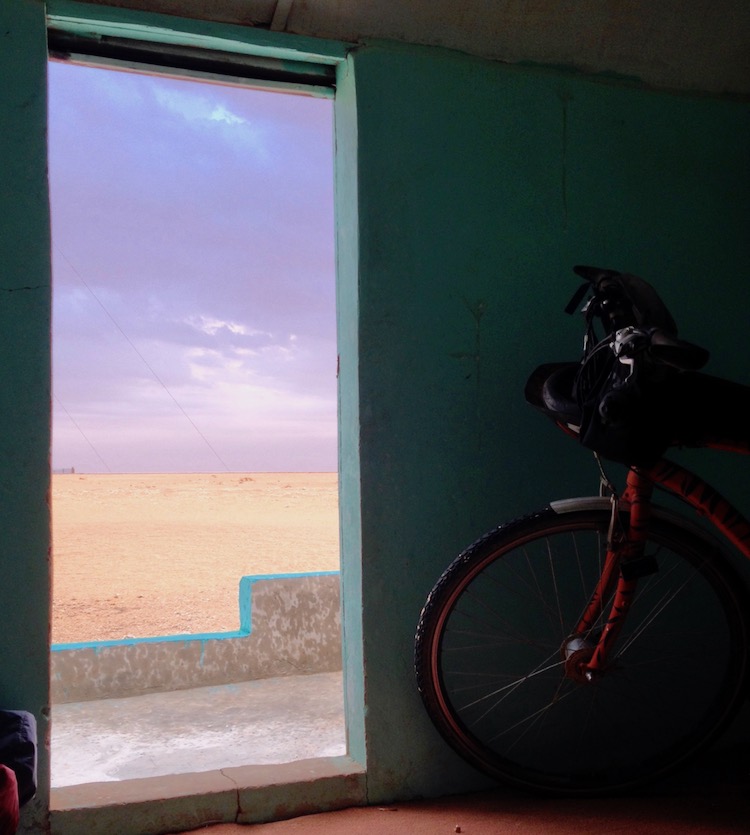
Here is a recording of the rain on the roof:
The next day was interesting. The wind was blowing hard, and was perfectly aligned with the road, which was lucky, because it was picking up huge amounts of sand from the surrounding dunes. The only comfortable thing to be doing was to be moving with the wind.
That morning, I had skipped my usual visit to the 'bathroom' (the toilet next to the hut was locked and the man had simply pointed to the desert when I asked about it). I paid the price for this.
I was on top of a hill when I needed to go, but luckily there were some small sand mounds by the road, providing tiny pockets of shelter from the wind:
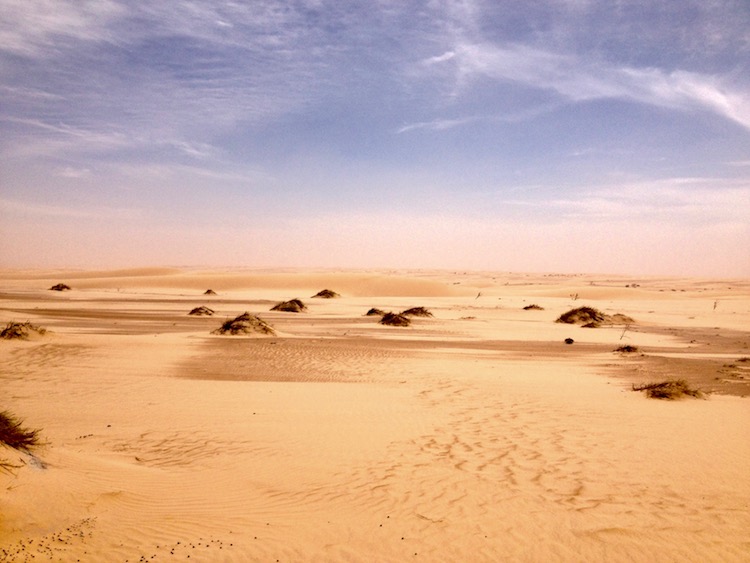
(You can see how much sand was in the air from the yellow haze that obscures the horizon.)
The problem was trivial, I just had to find a position amongst the mounds that was both sheltered from the wind and hidden from the road.
I wheeled my bike onto the sand and began searching, with the wind roaring in my ears and my teeth crunching on sand granules.
When I found a suitable spot (which was still not ideal), I fumbled with a roll of toilet paper, trying to prepare some pieces for myself, while feeling that slight panic that comes when you are desperate to go, but have to hold on for just a few more seconds.
Something I've learned on this trip, is that if you need to do your business in the wind (and want to use toilet paper), you must face the wind, otherwise the toilet paper can unravel and flap over your shoes and clothes (after you have used it). I'm sorry you had to read that.
Anyway, I squatted down, thinking how ridiculous the situation was, and at the same time as flying sand formed a layer of cement on my exposed, sweaty skin, I realised that I had sorely miscalculated my position: A truck drove by, and I was in full view for about twenty metres of road, but it was too late. Relief outweighed embarrassment, and I thought: Whatever. I will not meet these people.
When the job was done, I got back on my bike and flew along with the wind, feeling liberated. The way the sand blurred the horizon gave the landscape a fake look, as if it were computer generated. Here is a short clip:
Nouakchott to Senegal
The next day, I reached Nouakchott, where I stayed in a hostel for four nights, camping on my bed to escape the mosquitoes:
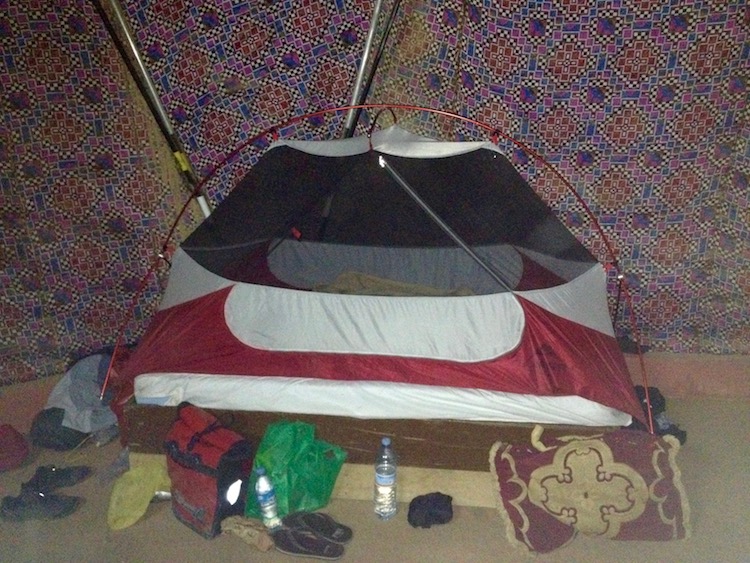
I relaxed, worked on this blog and ate lots of food. Then, feeling re-energised, I departed for the Senegalese border, which was three days away.
On the second day, I passed a police checkpoint and the policeman was holding a photocopy of a Swiss passport. He told me that two cyclists had passed by just ten minutes ago.
We are like ants in the sea, so it's always a surprise to meet each other, especially on the road. I figured that if I kept going, I might see them in the distance and be able to catch them up.
After about thirty minutes, I found them both sitting outside a shop with cold drinks. We chatted for a while, and then cycled on together, which was a lot of fun. The roads were flat and empty, so we could ride alongside each other, like a cycling roadblock.
Throughout the day, more greenery filled the desert, and something like grass began to appear (though very dry). There were also larger trees, and with them, the sound of wind blowing through leaves, which I realised I hadn't heard in a long time.
When we reached the Senegal River, there was an explosion of water and life:
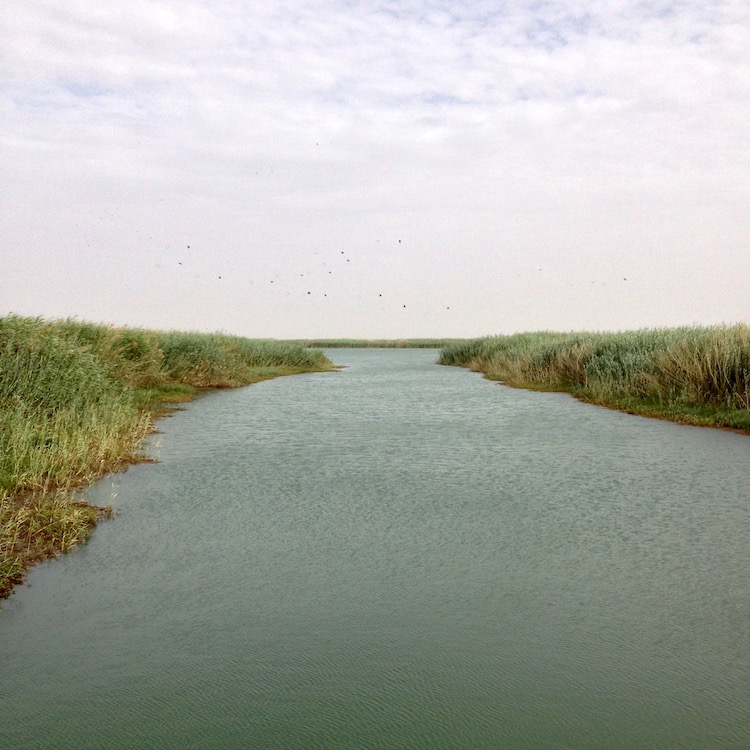
(This photo was taken from a bridge over one of the estuaries.)
And near here, the three of us found an unused, wooden shelter, which we made home for the night:

In the evening, we combined ingredients to cook a fantastic vegetable couscous:

And then slept like sardines on the floor.
Flo and Leo (from Switzerland and France) had left their respective countries within days of my leaving date, and had also met just four days before meeting me. It was interesting to see other peoples' routines while cycle touring. For example, Flo had filled a ten litre water sack in a village before we stopped, so he could have a shower in the evening! He also had a thick air mattress and bed sheets, which made Leo and I jealous, as we had the same, minimal Thermarest Z Lite mattress.
Despite having such a nice evening, I had a terrible night's sleep, getting devoured by mosquitos. It was too hot to get in my sleeping bag and there was not enough room for my tent (Edit: I should have just set it up outside).
In the morning, Flo and Leo said that they didn't notice the mosquitos, which made me realise that I am a mosquito magnet!
That day, we followed the Senegal River to the border crossing near Diama. The road was mostly sand and gravel, with a dense thicket of reeds growing on one side (from the banks of the river). It was disconcerting to hear loud rustling (clearly from a large animal) as we passed certain parts, because we had been told that the river was full of crocodiles. Usually, it was just a cow (disturbed by our bikes), but we also saw warthogs darting across the road, and a few times, a mother warthog with her piglets.
The border crossing went smoothly, with no visa required for Senegal, and on the other side, I left Leo and Flo to go straight to Saint-Louis, as they had planned to stop early in the village of Diama.
Senegal
For me, Senegal has not been pleasant. It is a poor country, and when locals see a white person, they seem only to see money, which is perhaps understandable. My name also becomes toubab, which means white person.
Invariably, cycling passed any group of children (or young adults), insights calls of, "Toubab!" and, "Cadeaux!" which means gift. I've also had many people simply say (in French), "Give me your bike," or, "Give me money," and if I stop at a shop, groups of children often form with their hands held out. I've bought sandwiches from street vendors and had my change (from a fairly large note) withheld, with the vendor pretending not to understand when I ask for it, or even raising the price (since they've already got the money).
But, all that being said, there were some exceptions, like a young man who found me napping by the road (I felt strangely exhausted) and spoke to me in English. He was genuine and friendly, and aside from asking me (half-jokingly) to take him back to England, he invited me into his house. I would have accepted, but I was on the tail end of a stressful three days, where I had been running out of cash and eating only bread and Laughing Cow cheese, so I was desperate to get to an ATM in the next town. There was also a street vendor who was friendly and gave me a big slice of watermelon (for free) after I bought some oranges.
Recharging
Now, I'm in the bustling city of Thiès, where I'm hiding in my (expensive) hotel and resting my legs and bum.
Here are some photos of the neighbourhood:
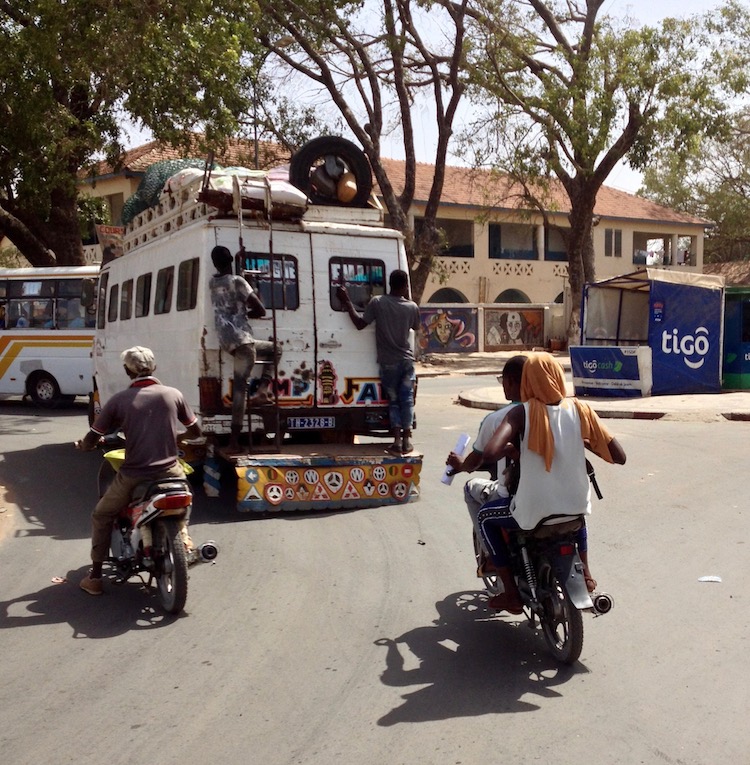 |
 |
And here are my ridiculous tan lines:
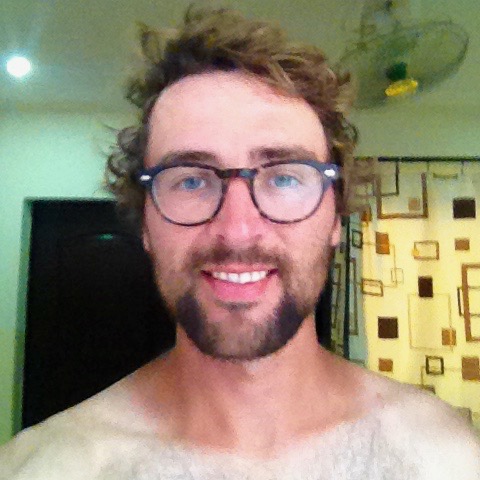
(It looks like my head was sewn onto the wrong body.)
On a lighter note, I got back to my room yesterday and noticed that my sandwich (from a street vendor) had been wrapped in pages from a Christmas edition of the Evening Standard (a British newspaper):

I'm curious to know how it got here (leave a comment if you know).
Moving forward
Senegal is expensive for a country that I find difficult to enjoy, so tomorrow, I will leave for The Gambia, which is about three days away. It will be interesting to be in such an exotic country and be able to speak English!

10 comments (add)
Clare: "Was about to send message to say we need an update. Really enjoying your candid blog; keep it up and more please. Clare x" 18/04/19
Dan Pugsley: "Thank you. I will try :D" 18/04/19
Lynn: "Enjoyed this so much! Love the pics, videos, audio and even the link to E. Toile (one of my favs) Looking forward to reading the next installment." 20/04/19
Dan Pugsley: "Ah I didn't know you were a Tolle fan :D Yeah I love his videos" 20/04/19
Julian Pugsley: "Your blog just gets better and better. Intriguing and funny. What's great about your writing style is that your personality comes though. You say that you put a lot of effort into it but the flow of the read feels effortless. Keep 'em coming and be safe." 20/04/19
Dan Pugsley: "Very kind words, thank you. It makes me feel better about putting so much time in, to know that it pays off." 20/04/19
Frances Forrest: "Oh Danny just found your blog. It's fantastic! I am In awe of your bravery. What an adventure! Xxxx" 21/04/19
Dan Pugsley: "Oh thank you 😊" 23/04/19
Kurt Hegllin: "Hi Dan, we met you at Tizi-n-Test pass in Maroc and now you are already in Senegal or even further. Thanks a lot for your fascinating blogs. It's so interesting to follow your journey trough the continent and trough your soul life. What is confirming to myself: It needs so less to get a fulfilling life. A bike and a good idea what to do with it. Wish you a good continueing. Best regards, Mona & Kurt from switzerland" 23/04/19
Dan Pugsley: "Yes absolutely, you realise how little you need. And can then appreciate more when it comes. Hope you are both well!" 23/04/19
Add comment