



I'm sitting alone in a two-person bedroom, in a guesthouse on a long stretch of road through Western Sahara. Through the open door, I can hear the owner, Mahfoud, talking near the entrance, where he watches the road for cyclists after being tipped off by police from the last road checkpoint.
I had heard about Mahfoud from Nico (a cyclist who I travelled with in Morocco). After waving them in, Mahfoud offers the cyclists tea, a hot shower and a room for the night, and when asked for the price, he says, "It's no problem," meaning that it's free.
Nico had been asked for 200 dirham (£16) in the morning by Mahfoud (which is very expensive), so as I read Mahfoud's guestbook, which he had handed to me as he made the tea, I was confused to find the testimonials showering him with praise. I was telling myself to drink the tea and then leave, when I read that the 'hot shower' he had mentioned was actually a hot spring, housed in the compound across the road.
Usually, when something sounds this good, it's disappointing, like restaurants advertising 'spécialité de pizza', but I remembered Nico mentioning the hot spring too.
After some internal debate, I decided that, whatever cost was sprung on me in the morning, it would be worth it to bathe in a hot spring in the Sahara Desert.
I quickly checked its legitimacy with Nico over the phone. He said, "It's hot, but not as romantic as you might expect."
Well, it was a blackened tub in a concrete building:
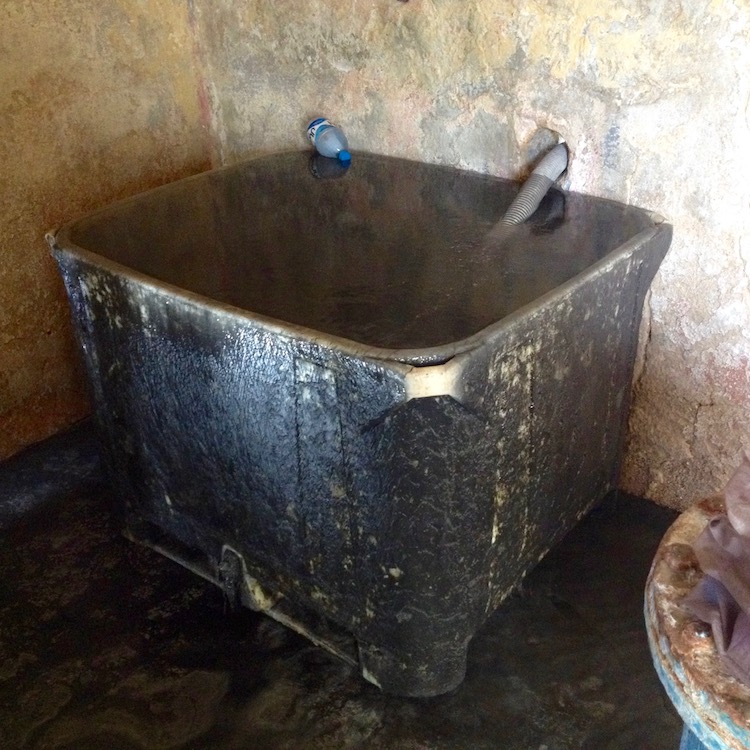
Mahfoud had walked me over the road and into the locked compound, through an uncharacteristic growth of plant life and into the room, where he had shown me what to do. To the right of the tub were some large pipes. He had grabbed a wrench and turned a valve on one of them, and suddenly I had understood how it worked: When the valve is opened, water flows from the pipe coming through the wall (visible in the photo), quickly flushing the entire contents of the tub (onto the floor) and replacing it with steaming hot spring water. The valve is left open, meaning that the water stays hot, but is constantly overflowing and running out the door, which felt wasteful, despite it being from a natural source.
Needless to say, sitting in the tub was blissful. I forgot about my surroundings (and the eggy, sulphurous smell) and enjoyed a feeling that I didn't think would be possible for many months.
As more water flowed in (I assume from deeper in the ground), it got very hot, so I closed the valve and washed myself, happy to have stopped.
Nico told me that Mahfoud asks for money right after you put an entry in his guestbook, which explains the glowing reviews. I'm ok with it, I'll give him 50-100 dirham (£4-8) tomorrow, depending on the rest of my stay.
The Sahara so far
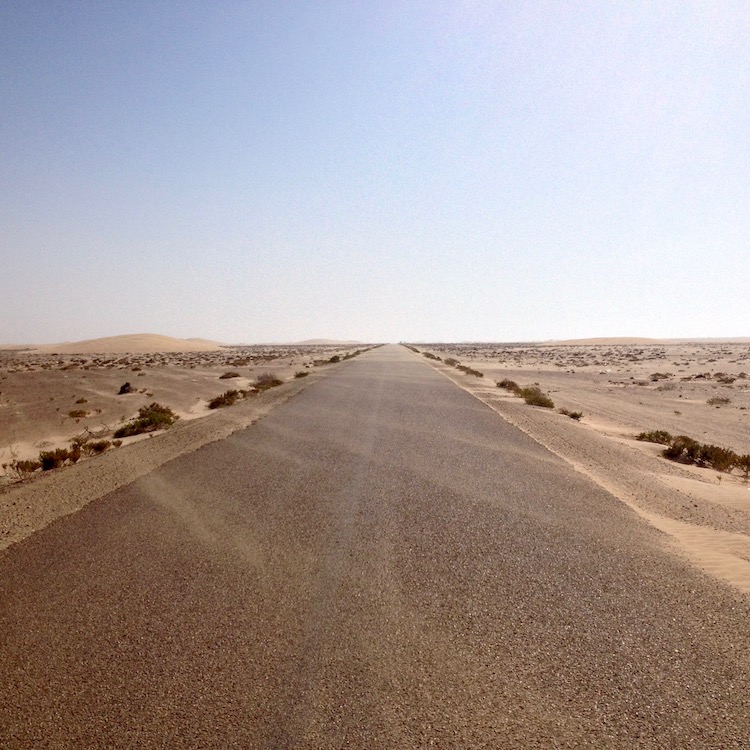
It has not been as lonely or inhospitable as I had expected. The most isolated roads have looked like this:
And a new sign has begun appearing:

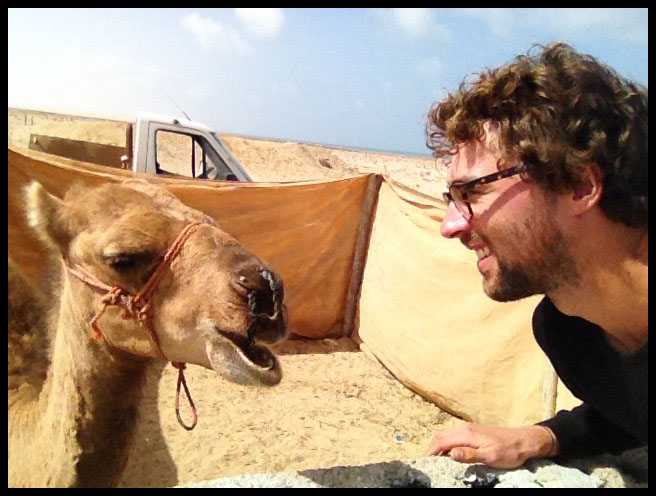
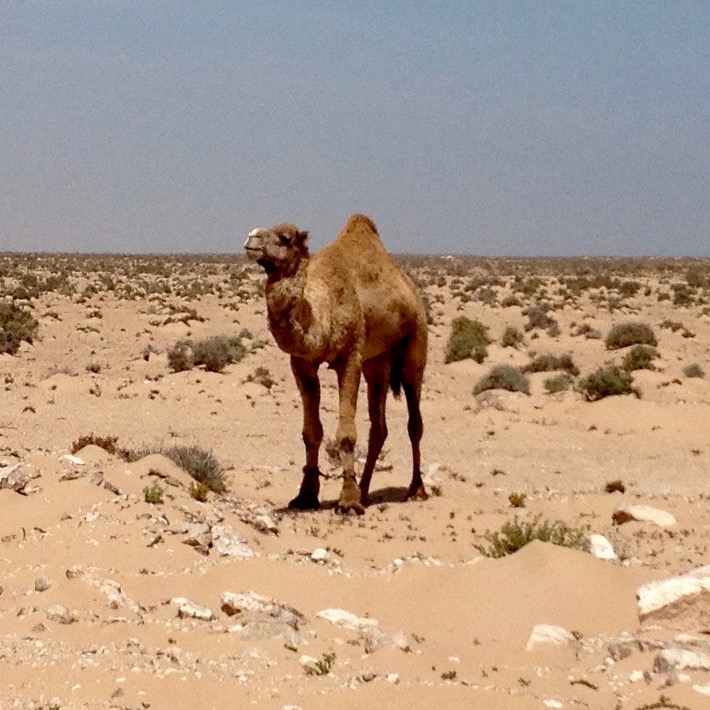
Here is the camel that posed for the image:
I'm hoping to see the classic, rolling dunes of the Sahara soon, as I've only seen small patches so far, but it's interesting to think that they move across the landscape, sometimes even crossing roads. Though they seem to get cleared when they do:

The beginning of my Saharan stretch was spent with Emmanuel:

An extremely sociable Frenchman, who has shown me that almost anyone can be approached. He told me that, on average, he meets about ten people a day, and I saw how this was possible. Here he is charging into one of the military outposts (often guarded by dogs) that line the coast of Western Sahara:

(I was hanging back, apprehensively, when I took this photo.)
The occupants are posted there for three-month stretches, where, aside from watching the ocean (their only job), they cook bread, watch satellite TV and play games on their phones. Emmanuel told me that they watch the ocean to catch people trying to leave the country by boat, possibly to the Canary Islands, which are just 100km from the coast at points. They seem bored and happy to welcome cyclists, having often given us water, bread and fruit.
In addition to the outposts, there are also a surprising number of shops and cafés along the route. I have stopped in lone shacks, where I've bought Laughing Cow cheese (popular all over Morocco) and Coca-Cola. And yesterday evening, while looking for a place to camp (and shelter from the wind), I found this isolated restaurant:

I had a cheese omelet, and asked the owner if I could camp near the building. He told me (in French) that there is a bedroom! When I asked for the price, he said, "It's no problem," and it was no trick. The room was dirty, and the door opened onto the car park (and did not lock), but the bed (a long cushion on the floor) smelt clean and I had a cosy nights sleep, listening to the howling winds outside.
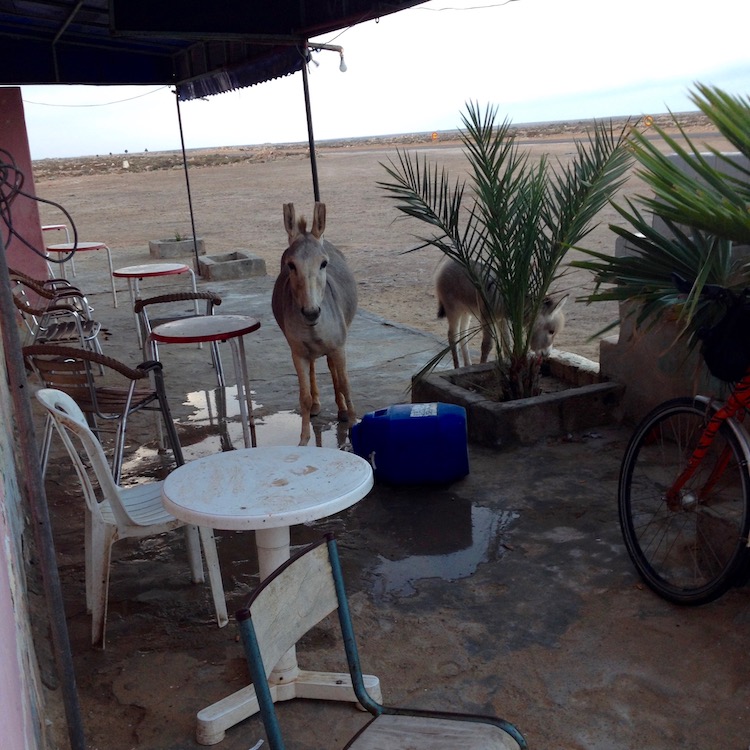
In the morning, I woke to strange sounds outside the door, and opened it to catch a donkey and her foal drinking the washing water (they had poured it on the floor):
The wind
Along the coast of Western Sahara, the wind almost always blows south, reaching speeds of up to 40km per hour. Yesterday, I cycled 137km in five hours, which is huge for me (and not normally possible). But my ego was deflated today, when I met two cyclists who had covered 340km in the same day (they had far less luggage and carbon fibre road bikes).
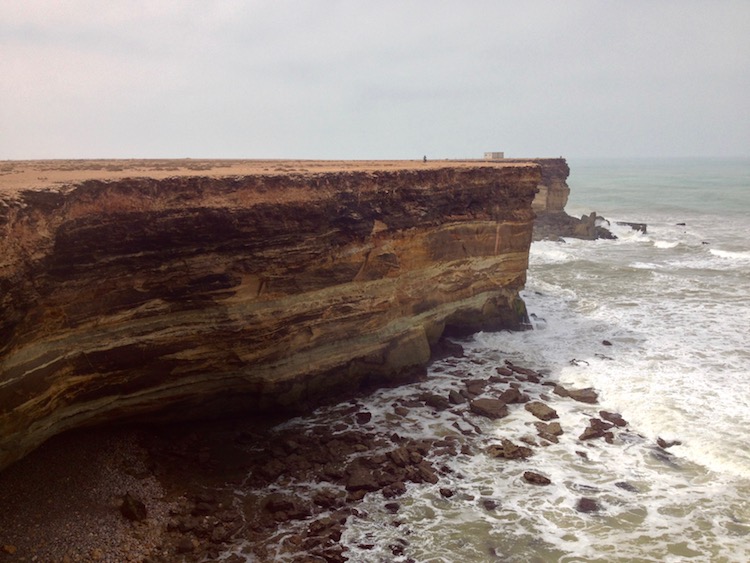
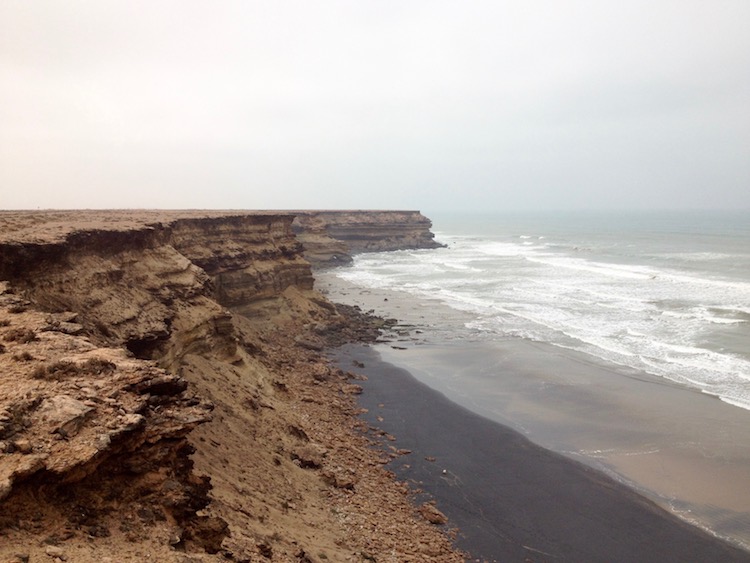
Here are some photos of the beautiful coastline:
 |
 |
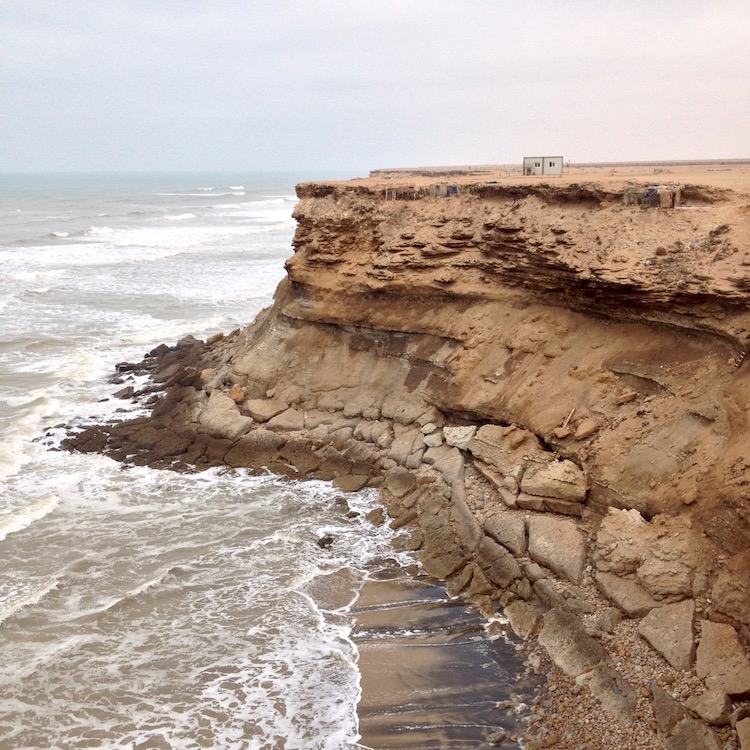 |
In the last one, notice the makeshift huts of the fishermen, built into the cliffs like bird nests. Click here for a close-up.
And here I am, rather ingeniously using my camping chair as a wind sail (the effect was minimal):

The police
Since Western Sahara is a disputed territory, there is a strong police presence from the Moroccans. The police have been both funny and frustrating. The most frequent contact is at road checkpoints. These can become annoying because you end up stopping many times a day for the same passport check and questions (nationality, occupation and destination). But, they are friendly, and (I assume) are only concerned about safety (especially after the recent Atlas Mountain murders).
However, as nightfall approaches, the police can get quite forceful about where you will sleep, preferring that you stay in a hotel, for safety and—I think—so you are paying.
While cycling with Emmanuel one evening, we had stopped beside the road for a snack, when a policeman pulled up in an old, unmarked car and asked where we were going. I told him that we were headed to the next town, which was true, though we were planning to go through it and camp on a beach on the other side. The policeman urged us to stay in a hotel, listing some reasonable prices, to which I nodded, but tried not to agree. Eventually, he drove on, but I noticed him pull over in the distance, putting his hazard lights on. My best guess was that he thought we were trying to camp on the beach right next us, and wanted to make sure that we actually made it to the town.
We began cycling again, and as we passed his car, I started waving at him, until I realised that he was completely ignoring us, and instead, had suddenly began to wash his windscreen.
For the next hour, this continued. He would stop ahead of us and pretend to be doing something (like napping) as we passed by, as if we couldn't recognise his car. This was both funny and strange, but I guessed that we could lose him in the next town, to avoid being forced into a hotel.
When we arrived in the town, the policeman finally acknowledged us. We then rushed around the shops and stalls, buying ingredients for dinner (before it got dark), and in doing so, managed to lose our 'tail'.
Just before sunset, we were almost free on the other side of the town, when another policeman spotted us and pulled us both into the police station (for a passport check). Our 'tail' appeared again, and we were held up until it got dark. With little choice but to stay in a hotel, we took one of their recommendations, which was cheap (30 dirham/£2.40 per night), but had no shower, and I would have preferred to camp on the beach (or in the desert) for free.
The next evening, we were almost forced into another hotel by the military, and the morning after, Emmanuel and I decided to split and meet later on (the social interactions were wearing me down and I wanted to be alone for a bit).
That day, I departed for Boujdour, 170km away, expecting a night in the desert. This was another day of good winds, and by 6pm, I had covered 120km. The sound of my wheels whirring on the road had become addictive, and with two hours until sunset, I decided to try and reach Boujdour that evening, setting a huge distance record for myself.
After 10km, I ran into another police checkpoint. I was checking my watch as I waited, trying to signal that I was in a hurry. The policemen had started making phone calls, which was unusual, and just when I thought they would let me through, one of them said, "You will sleep here tonight," pointing to the half-built gas station next to the checkpoint. With my record so close, I claimed that I needed to be in Boujdour that night. More phone calls followed, and their compromise was to drive me to Boujdour. I explained that I had cycled every meter from England (except for the sea) and couldn't accept a lift. "Then it's a problem," was the man's response. I decided not to push it any further. I don't think they had the power to hold me, but I didn't want to test that situation, and I had also realised that the gas station was not such a bad place to camp: It was safe (the checkpoints are open 24/7), it was sheltered from the wind and I would have use of the checkpoint toilet (one of the few that I'd seen with a sink and soap).
I set up only the inner part of my tent that night, as the humidity was low and it would give me a view of the stars:

The next day, I arrived in Boujdour early and stayed for two nights in a hotel (to rest). Here is the dusty sunset from my hotel entrance:

From Boujdour, it was just one day before I met Mahfoud.
Run-up to Western Sahara
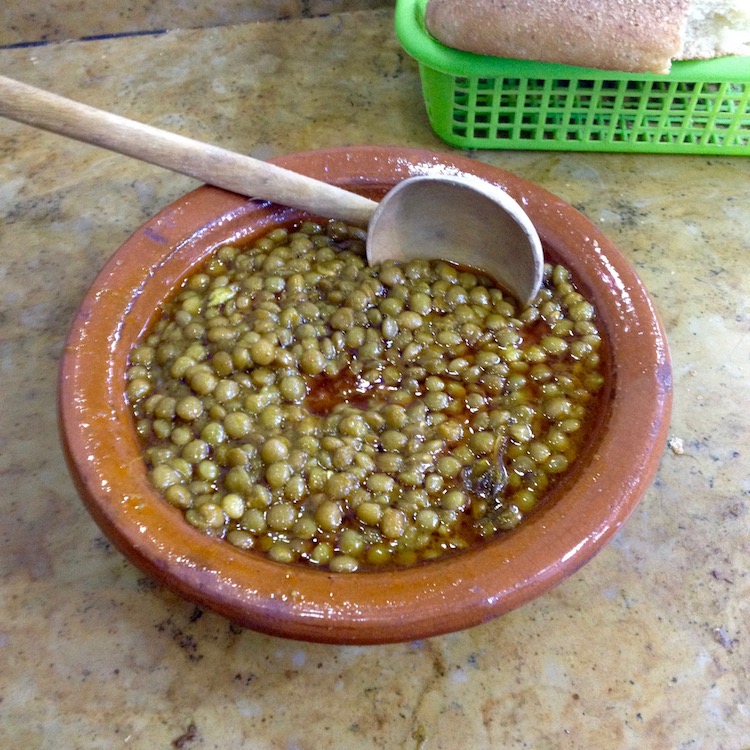
My previous post was so long that I spent four days in Marrakesh trying to edit it, while eating lentils (10 dirham/80p with bread):
I spent the next week cycling a mountain route to Agadir, where I used every free moment to do another pass on the post. I even stopped for two nights at 2000m (camping in a guesthouse car park), which I used for solid editing, and almost ditched the post out of frustration.
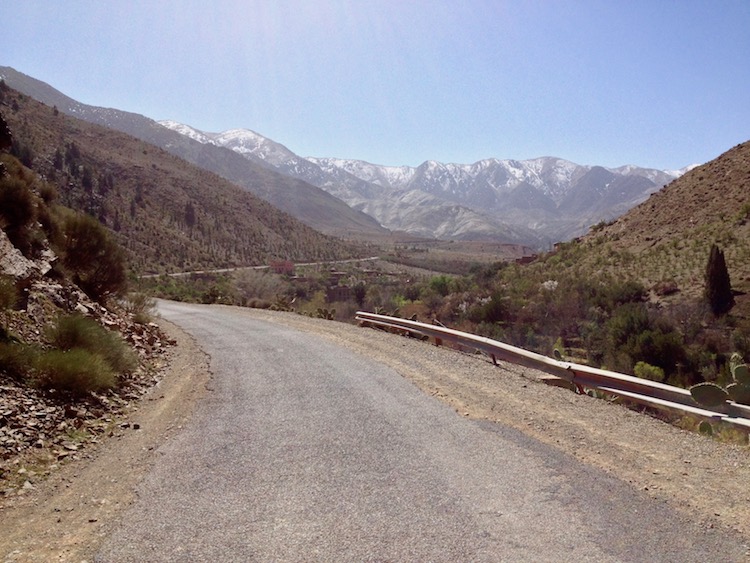
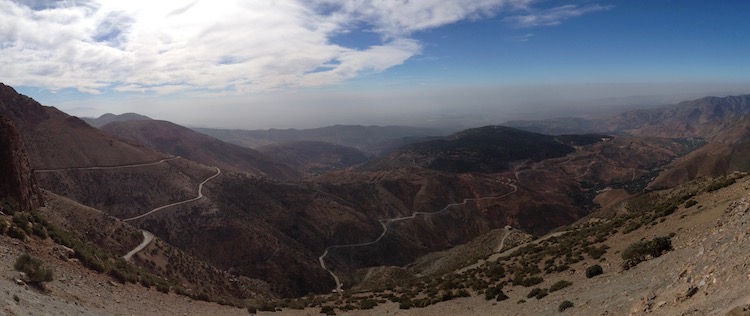
Aside from the distraction, the scenery was beautiful. Here is a photo from the bottom of my climb to 2000m, and then another from the top, looking down on the road I had just cycled up:
 |
 |
In the mountain pass (where I stayed for two nights), it was so peaceful that I recorded the location and took the email address of Hassan, the guesthouse owner, with the idea that I could return in the future, to write.
Hassan had served this breakfast each morning (for 20 dirhams/£1.60):

(Olive oil, butter and jam for the bread, mint tea, and semolina porridge, which was heartwarming on the cold mornings.)
This was also the highest point that I have ever cycled, and the descent was phenomenal. But before I began, I met five other cyclists, all admiring the same view (though headed in the opposite direction):
Here I am exchanging details with Kurt, a cycle tour leader:

And here is a short clip from the beginning of the descent:
(I'm trying to avoid potholes, while simultaneously filming the view, which is why the camera is all over the place!)
Agadir and being a student again
I had just passed through Taroudante, on my way to Agadir from the mountains, when I heard the click of bike gears behind me. I looked around to see a Moroccan man pedalling close, using me as a wind break. I laughed and shouted (in French), "It's good!" pointing at the ground directly behind me. With all my luggage, I make a good wind-break.
Eventually, the man pedalled alongside me and we began talking. He told me that he had two sons studying in Agadir and when I said that I was going there, he immediately stopped and called one of them, telling them to host me. I felt bad for this poor student, being forced by his father to host a stranger, so I didn't agree right away (I wanted to give him a chance to refuse later).
That night, I camped in a field by the road, and the next morning, I found messages on my phone from Mohamed (one of the sons), telling me that I was very welcome to stay, which was reassuring.
I had wanted to skip Agadir, as I had heard that it was not beautiful (an earthquake wrecked the city in 1960), but it had a Decathlon, which was my last chance for bike repairs before the desert. So on my way into the city, I dropped my bike off for a new chain and gear cassettes, then jumped in a taxi to Mohamed's apartment.
The taxi driver dropped me at a roundabout in the suburbs, with a derelict plain on one side and tower blocks on the other, and I waited there nervously for Mohamed, still feeling bad about the situation.
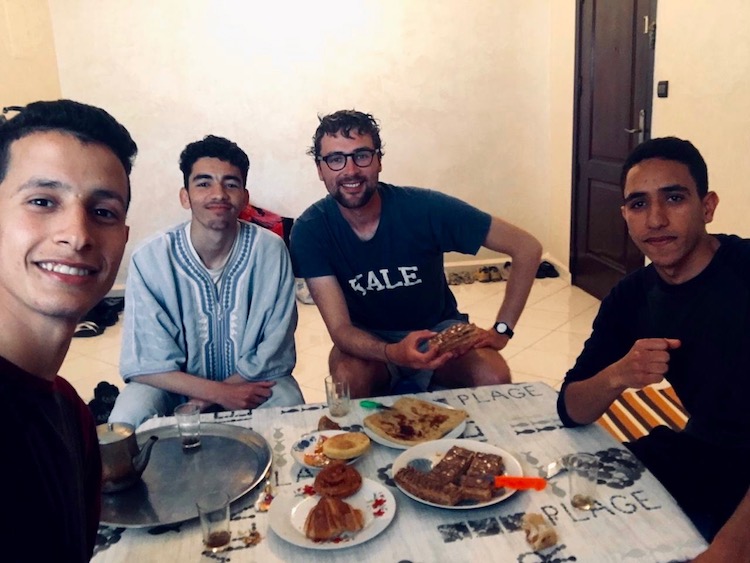
When Mohamed walked around the corner, I immediately relaxed. He was warm, friendly and seemed genuinely pleased to have me stay. He led me up to his apartment, where he lived with his brother Youssef, cousin Mohamed (it's a popular name) and friend, whose first name was so complicated (for an English tongue) that they told me to use his last name, Hani. They were all around 18-20 years old, and nerds, which suited me. They were also so welcoming and friendly, that I stayed for two nights and had one of the most relaxing days of my trip. They cooked dinner, we chatted about games, Islam and cycling, and we watched Bohemian Rhapsody (the movie about Queen). In the morning, we ate breakfast together (fresh msemen and pastries from a local bakery) and then later, they cooked lunch. The cousin, Mohamed, who was the most talkative, said, "You only have to relax," when I offered to wash dishes.
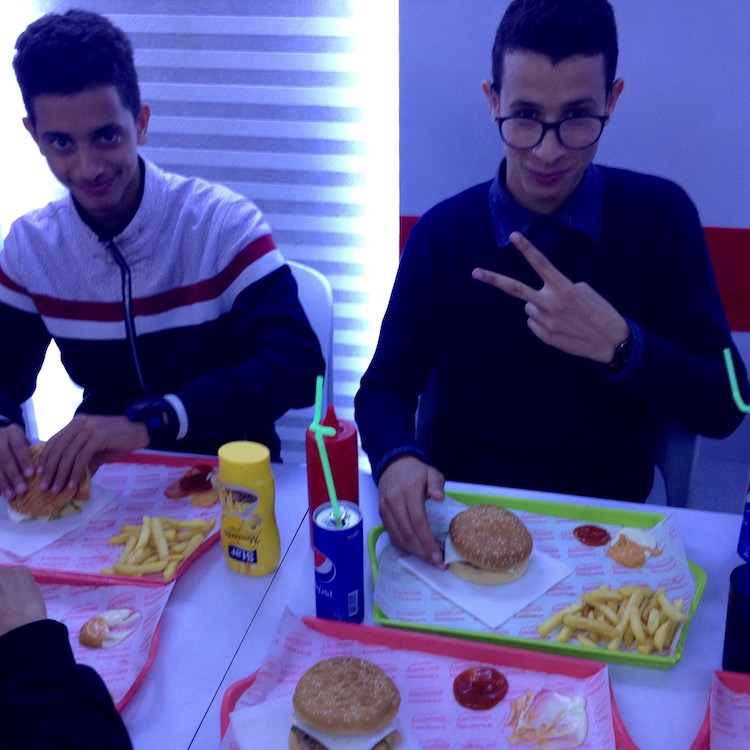
That evening, I invited them all out for dinner, in the hope that I could pay for it, as a thanks for their hospitality. We went to a 'snack' restaurant, which means 'fast food', and was their favourite place to eat out. We had burgers, fries and Pepsi and it was great. And against my will, they paid for everything.
After leaving the restaurant, we wandered the streets. The students taught me some words in Arabic, like 'bread', 'water' and 'oats', and how much I should pay for these things in shops. They said that I shouldn't ask for the price, I should just give the right amount.
There was a moment in this evening, which I realised I would always remember. We were walking down a street, the air was warm and I could hear the soft chatter of the students (in Arabic), mixed with the sound of insects coming from the derelict land beside the road. The street lamps bathed the scene in amber, and I thought: This is one of the small pool of moments that will stay with me.
Of course, with this thought, the moment fluttered away, so I tried to stop thinking and enjoy the sounds again.
Earlier that evening, the students had shown me a YouTube video of people doing parkour (or free-running) in Brazil: Jumping across the roofs and alleyways of the favelas. In my moment of relaxed contentment, I decided to try a parkour move and jump from one side of the central reservation to the other (a basic move). "Let's do some parkour," I said, then jumped and fell flat on my back in the road, snapping me back to reality. We all found this funny, and when I left, they summarised my learnings:
- Don't pay 5 dirham (40p) for bread (it should only cost 1).
- 'Afek aetani lamoh' - the Arabic for asking for water (I have just written this as I heard it).
- Don't do parkour.
Thank you so much for looking after me!
 |
 |
Changing landscapes
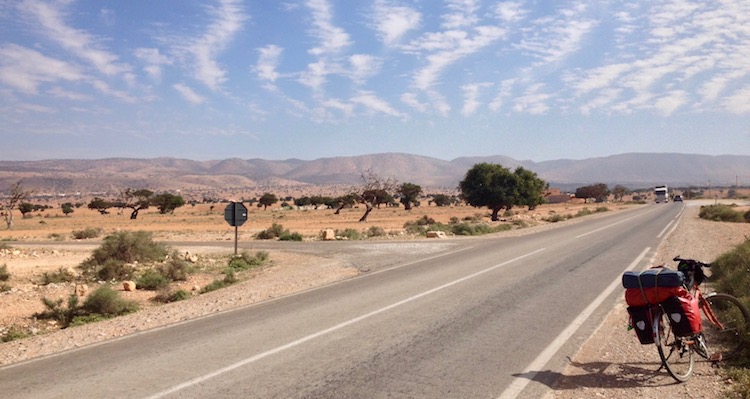
From Agadir to the border of Western Sahara, bushes and trees slowly turned to sand and rock:
 |
 |
 |
And one night, I found this critter next to my tent:
I had lifted up a rock (to push in a tent peg) and learned that I shouldn't lift up rocks. This was apparently a dangerous one (despite being small), because of the small pincers and yellow colour. I let it walk away, but made sure to shake out my shoes in the morning.
Two days from Western Sahara, I stopped for two nights in the coastal village of El Ouatia, which turned into five as I found the place so relaxing. I set up my tent on a campsite, facing the ocean, and woke to the sound of waves each morning:

During this time, I also met with Nico again, for a hedonistic night of eating in the village centre:

And while eating lentils everyday, I built a comments section for this blog!
And now begins my masochistic process of editing. I hope you have enjoyed the results!
For those interested, here is my route and current location:


19 comments (add)
Emmanuel: "Pleased to read your feeling about the road we shared :) Hopefully we'll meet again !" 01/04/19
Beo: "Love every single bit of it beo! I can't wait to hear more about your adventures👀☝️" 02/04/19
Mandy: "Keep the stories coming!! Be safe & enjoy the adventure!!" 02/04/19
Mum: "Another great post Dan! That road in the mountains looked a bit scary though! I am looking forward to reading it all again!" 02/04/19
Meg Price: "Absolutely loving your blog. What an adventure. You make it sound really beautiful .. I can imagine the whole trip." 02/04/19
Dan Pugsley: "Thanks Meg :)" 02/04/19
Joe Fitz: "Really enjoying this blog, the writing is really good. Looking forward to the next update!" 02/04/19
Dan Pugsley: "Ah thanks Joe, that's nice to hear. Hope you're doing well 😬." 02/04/19
Ruth: "This is an amazing blog! It’s so exciting to read and I can’t wait to hear the next instalment. Well done for writing it ... oh and well done for cycling across the Sahara too!" 02/04/19
Dan Pugsley: "Haha thank you for the kind words! Yes, just recently I was in a hut by the road, surrounded by sandy plains, and heard something falling on the roof. Then realised it was rain, and that I was almost out of the desert! It has felt never ending at times with the long, featureless roads." 02/04/19
Lynn: "Your latest post was well worth the wait! Love the writing, tips and pics. The critters...make sure those stay behind;)" 03/04/19
Roger Price: "Dan u r da man. I love your blog and look forward eagerly for each one. Everyone I know who follow u ate excited and impressed. Wot a wonderfully adventure. Love from the cost." 03/04/19
Dan Pugsley: "Ahh thanks very much Rog 😊" 03/04/19
Becca: "Just WOW! So fascinating and so entertainingly told. Can't wait for the next installment but I will be re-reading this one as there is so much in it! xx" 04/04/19
Dan Pugsley: "Oh thanks for the encouragement Becca, it helps me to keep writing :)" 08/04/19
Sarah: "Hi Dan, love the blog, you bring the journey to life, the amazing scenery and cultural interactions but also the trepidation of new experiences. you must feel so much freedom on the road. good luck for the next stage. i will forward your link to Bryony." 05/04/19
Dan Pugsley: "The most free feeling is when I've loaded up on perhaps two days of supplies, and then head out of a city, as there are almost no constraints. But some of the time I am tied to a destination because there is an ATM, or a supermarket :P. Foraging for food is the next step I suppose! Thank you :)" 08/04/19
Rachid: "Lovely meeting you in Tarifa back in February. Now that I am now back in China, reading your stories make me understand how much those moments, experiences do matter in our respective journeys. You are probably learning more about yourself than ever. Bonne route/trig slama and I hope Mama Africa (this lovely continent) will take care of you!" 07/04/19
Dan Pugsley: "Thank you Rachid! Yes, learning a lot. Hope China is taking care of you :D" 08/04/19
Add comment